





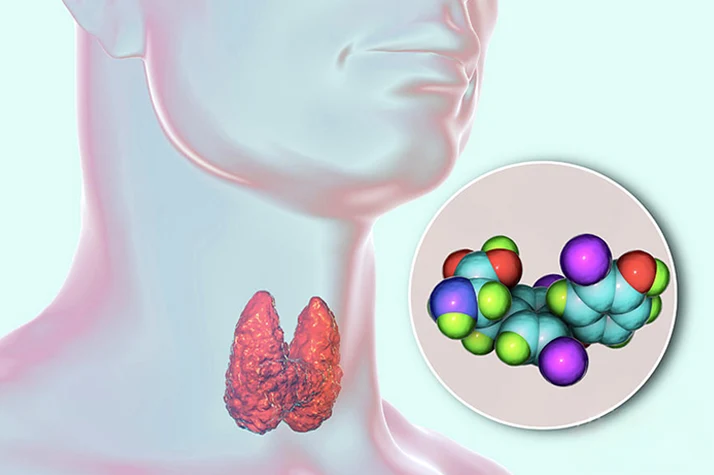
If you’ve ever lived with hypothyroidism, you already know the drill: fatigue that feels like it’s baked into your bones, stubborn weight that refuses to budge, cold hands even when it’s 40°C outside, and that foggy, “where did my brain go?” feeling.
Most people start on levothyroxine (T4). It’s the default. The go-to. The globally accepted standard. And for many people, it works beautifully. Symptoms settle, bloodwork normalizes, and life moves forward.
But for a surprising percentage of patients… something still feels off.
Labs look “perfect,” yet they don’t feel anywhere close to it.
That’s where the conversation around T3 (Liothyronine) is starting to get interesting again.
Why T3 even matters
A two-minute physiology refresher:
Hypothyroidism: A condition where your thyroid can’t produce enough active hormone, leaving tissues starved of T3 despite ‘normal’ lab numbers in some cases.
Hashimoto’s thyroiditis: An autoimmune form of hypothyroidism where the body attacks the thyroid, often leading to lifelong hormone replacement and variable T4 → T3 conversion efficiency.
T4 is the storage hormone. Think of it as the raw material.
T3 is the active hormone. It’s the molecule that actually docks into your cells and does the metabolic magic.
Your body normally converts T4 to T3 on its own through enzymes called deiodinases.
But, and here’s the kicker, not everyone converts efficiently.
So even if your T4 looks stellar on a blood test, your tissues might still be running low on T3. And hypothyroid symptoms don’t really care what your lab report says, they care about what’s happening inside the cell.
Enter Liothyronine (T3)
Liothyronine is basically the “direct” version. The active hormone itself.
For years, combo therapy (T4 + T3) had a bit of a reputation problem. Too aggressive. Too stimulating. Too unpredictable. Doctors avoided it, patients didn’t fully understand it, and pharmacies didn’t always have it.
But now? The landscape is shifting – this is where we might take some credit, more on that soon!
The other interesting bit?
Rather than relying on standard T4 alone, we will use a slow‑release T3 formulation alongside T4. This approach ensures that T3 levels rise gradually, mimicking natural physiology, and avoids the peaks and troughs seen with immediate‑release T3. Importantly, T3 is never given in isolation; it’s always paired with T4 to maintain long-term stability and prevent overtreatment. By targeting both hormones, we address the gap between lab results and actual tissue-level thyroid activity, helping patients feel more energetic, clear-headed, and balanced.
So who might benefit from adding T3?
Not everyone. Truly not everyone.
But possibly:
- Patients who feel persistently hypothyroid despite being on adequate T4
- Those with low T3 levels in the context of normal T4
- People with certain genetic variations affecting T4→T3 conversion
- Individuals whose symptoms improve temporarily when T3 is introduced, then regress once it’s removed
It’s a niche group but a very real one.
Why T3 isn’t easily available
T3 isn’t easily available for several reasons. Many pharmacies don’t routinely stock it, and most clinicians weren’t trained to prescribe it. Historically, guidelines favored T4-only therapy, partly because TSH levels looked “normal,” giving the impression that patients were adequately treated. Only recently has mounting evidence, from genetic studies, tissue-level research, and clinical trials, shown that some patients continue to struggle on T4 alone, so availability lagged behind demand.
If you’re hypothyroid and still not feeling like yourself, even if your labs look “fine”, it’s worth having an informed conversation with GluCare that is well equipped to provide you with this combination therapy.
Because the whole point of thyroid treatment is to feel human again.
And for some people, T3 is the missing piece.