



If someone told you that resting your arm on a small device for 12 seconds could reveal how your blood vessels have held up over the years, you might raise an eyebrow. But that’s exactly what’s happening in clinics today and it’s changing the way we think about early health screening.
Let’s break down what’s actually going on, why it matters, and why more people are starting to ask their doctors about it.
Your Skin Keeps a Record of Everything
Here’s something most people don’t know: your skin isn’t just a surface. It’s more like a slow-developing photograph of everything your body has been through including years of sugar, stress, sun, and everyday wear and tear.
The technical term for what builds up is Advanced Glycation End Products, or AGEs. These are natural compounds that form when sugar in your bloodstream binds to proteins in your body. Over time, they accumulate, especially in people managing diabetes, kidney issues, or long-term inflammation, and they don’t just sit there quietly. They’re linked to stiffer blood vessels, slower healing, and increased cardiovascular risk.
The more AGEs your body has built up, the more “wear” your vascular system has likely experienced even if you feel completely fine.
Why This Matters More Than a Blood Sugar Number
Most of us are used to health check-ups that measure a single moment in time – a blood sugar reading, a cholesterol number, a blood pressure cuff squeeze. Useful, but limited. They tell you how things look today.
AGEs work differently. Because they build up gradually and don’t fluctuate with what you ate for breakfast, they act more like a long-term memory of stress on your body. That makes them a genuinely different kind of insight. This is part of why researchers have spent nearly two decades studying them. There are now over 300 published studies linking AGE levels to vascular health, particularly in people with diabetes and kidney disease, where the risk of complications is highest.
The Surprisingly Simple Way to Measure It
For a long time, measuring AGE buildup meant a skin biopsy, not exactly something you’d want as part of a routine check-up.
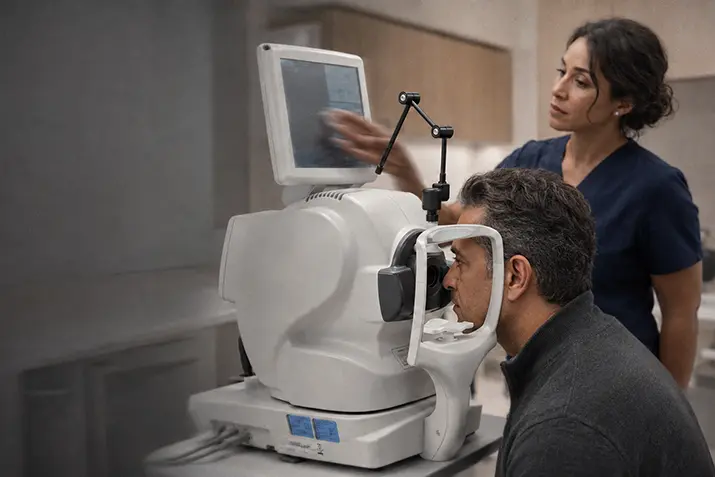
Today, there’s a much simpler option: a light-based scan that reads AGE levels directly through the skin, painlessly, in about 12 seconds. No needles. No blood draw. No waiting days for lab results. You rest your forearm on a small device, and that’s it, the reading is instant.
It sounds almost too simple for something with this much science behind it, but that’s really the point. Early detection only works if people actually do it, and a 12-second scan is about as easy as preventive health gets.
Who Benefits Most From Knowing Their AGE Levels?
While anyone can get real value from understanding their AGE levels, a few groups tend to find it especially useful:
- People managing diabetes, since elevated AGEs are strongly tied to long-term complications
- Those with kidney concerns, where AGE buildup tends to progress faster
- Anyone focused on cardiovascular prevention, especially with a family history of heart disease
- People tracking lifestyle changes, since repeat scans can show whether diet, exercise, or treatment shifts are actually making a difference over time
- Anyone interested in healthy aging, since AGEs are also connected to skin elasticity and visible aging, not just internal health
The Bigger Picture: Prevention You Can Actually See
We talk a lot about “catching things early,” but in practice, that’s hard to do when most warning signs are invisible until something goes wrong. This is one of the few tools that gives a tangible, visible number for something that’s usually silent.
It won’t replace bloodwork or a conversation with your doctor. But as one more piece of the puzzle, it’s a remarkably simple way to see what’s been building beneath the surface, before it becomes a bigger story.
Curious what your own numbers look like? Ask about it at your next check-up, it takes less time than making your coffee.